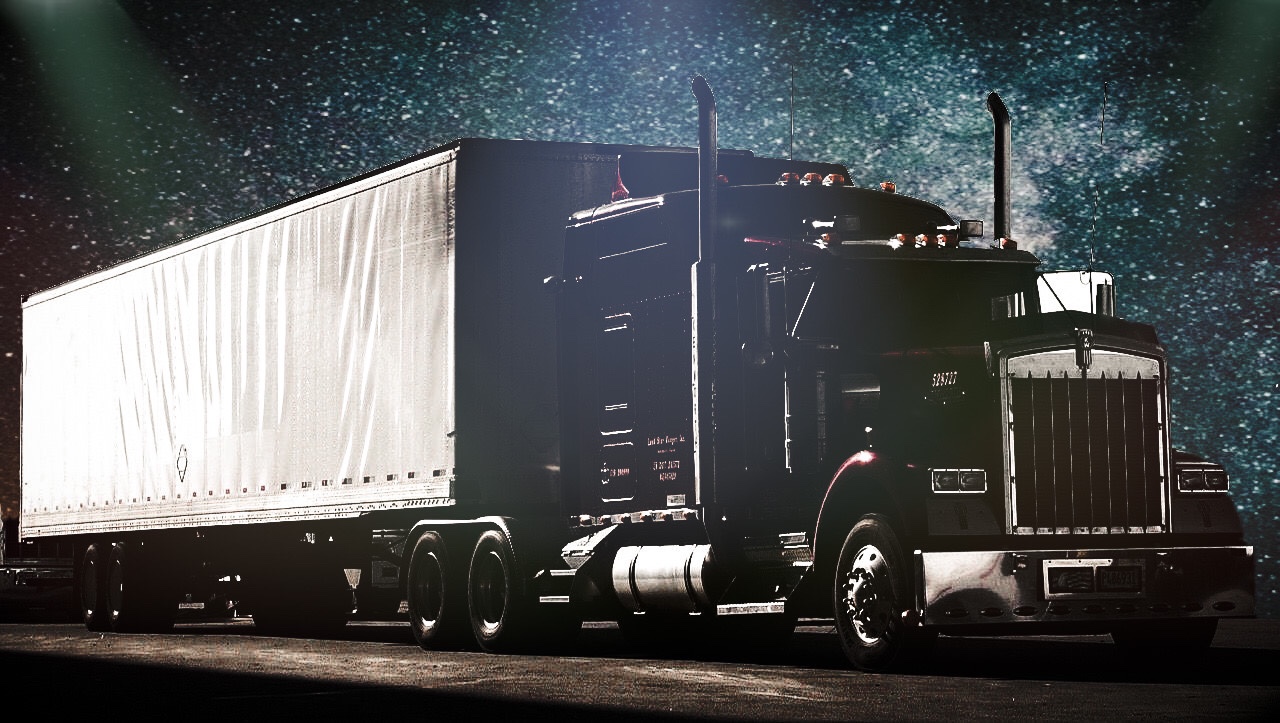
Connie saw the Light almost as soon as she started driving for Peepers Trucking.
Despite the expression, it had not been the light of sudden, overwhelming comprehension, though she had seen that kind of light, too. That light had been the light that had ended her marriage, withering the deadbeat Ronnie and illuminating a new path for Connie. This eventually led Connie to a post-divorce spree of radical selfhood that had manifested variously as a tattoo, a fierce compulsion to travel, and a commercial driver’s license.
But she wasn’t talking about seeing that kind of light, even though that had been pretty positive on balance. Nope, Connie was talking about seeing the actual light. The literal light.
The Light.
Connie downshifted as her red Kenworth began a winding incline. The sloping road that hugged the edge of the hill wasn’t precariously steep. It was a lazy swelling of the earth that seemed to soften under the old rig, the kind that would make locals cuss when they got caught behind the long trailer.
If this place had locals at all, there were none present this evening as the Kenworth hauled its crust of road grime over their solitary highways.
The First Light had been many years ago. Ten years. Fifteen, maybe. Sometimes it felt like an eternity, Connie thought. But here she was, driving for Peepers, with their red trucks and white trailers. It was an odd outfit, but they left her alone to drive, and Connie was fine with that.
The evening was cloudless, and the first, probing thrusts of the night chill were working past the truck’s windows. The road clung to sheets of cracked, wine-hued granite, bleeding streams of primordial groundwater. But on the gentle rise, where Route 100 had been cut into the earth, the bare stone gave way quickly to grassy cover and generously spaced birch and maple that climbed away from the roadbed toward the crest. The October sun was not quite behind it yet, and its rays twined languidly around the edges of every leaf, bathing the interior of the cab in fluttering waves of gold.
She took her eyes off the road for a moment and looked to where the road fell away into the valley. Far below her, the gunmetal vein of a river slipped through the denser forest of the lower elevations. The blaze of orange, red, and yellow throughout the valley countered the tranquil glow of the trees immediately above her, as if the skyward forests had focused the sunlight. Farther yet, the deepening sky met the distant, dying leaves at the hard border between time-bound Earth and the eternal stretch of the universe.
It was very pretty, thought Connie.
She’d been told that she had a knack for dismissing extravagance. She put it more plainly: no bull crap.
A small sigh escaped Connie’s lips as her eyes refocused on the pavement. Something in her acknowledged the beauty of her surroundings. Had she not seen the Light, of course, it might have been different. Connie Macklin—plus or minus 50 years old, divorced, and possibly insane—might have let the glory of that autumn prospect fill her with joy.
But she couldn’t. Because it was nothing compared to the Light.
The chunky gurgle of the Kenworth’s engine rose as the truck pushed upward around another bend, bringing the setting sun into full view. The square double panes of the truck’s windshield were like an enormous version of Connie’s own oversized, Sears-knock-off Von Furstenbergs. She brushed her bangs away from her face as the glare thrust into her field of vision. Her hair was getting a little mousy because she hadn’t washed it for nearly a week, and the gray was starting to show a little more than she was comfortable with. Then again, she spent about ninety-percent of her life alone in a truck cab. Ninety-eight, maybe.
She needed a change from all this driving. It had its advantages, of course: there were places that she needed to be, and she needed to be there at times that she needed to be there. It was good to know that about one’s life—simple. But it seemed to Connie that she could go other places; that she could be taken to other places and see other things. Something new. It wasn’t simple, but it was healthy. Like surgery.
Her left hand released the wheel for a moment to toggle the headlights and trailer markers. Dusk came quickly this time of year. The road straightened briefly as the Kenworth pulled its plain trailer over the crest of the hill, and Connie took the opportunity to look at the map.
It lay half-folded in the passenger seat, whose uncracked vinyl showed nary a coffee stain or other sign of use. Even as the cab grew dark in the fading day, she had little difficulty picking out her route on the map. The heavy black line she’d drawn flowed north, twisting and juking over narrow country roads, avoiding the already sparse pockets of civilization. Connie flicked her wrist to bring the top of the map upward. The crisp paper snapped obediently, and the northernmost end of that dark line came into view, terminating in a small X near the Chester A. Arthur Birthplace on 118.
No time was noted, but Connie had no concerns.
She released the map. The sun had finally slipped behind the horizon, leaving only a feeble pink glow at the edge of the sky. The route was an easy one, she thought. The routes weren’t always as forthright, but they were always as certain, and they always ended the same way: with the Light.
There were other maps—twelve of them—used once apiece. Each with a single, black line that might wind and gyre toward its terminus, or that might shoot straight for the black X like an arrow into a wound. Twelve maps used once and afterwards folded carefully, pressed flat, and placed under the passenger seat.
She tried to push the thought of those other maps away, but a sense of foreboding filled the cab. What if she had to fold this map, too?
Connie focused her mind on the act of driving. The sensation of the road through the wheel, tugging softly at her hands. The muscles in her right calf making minute adjustments to the pressure it levied on the accelerator pedal, rocking it gently to keep the rig’s speed steady.
It was completely dark now, and in the headlights, Connie saw only the fast-moving river of asphalt before her, confined by the rocky, overgrown banks of the narrow shoulders. The needle of dread withdrew slightly as she felt the contours of the pavement beneath her, bumps and shocks reduced to a lulling roll under the great bulk of the truck, and the throaty voice of the engine saturated the cab, rumbling contentedly in Connie’s chest. It seemed almost to push her back into the old foam pad that sat between her and the vinyl upholstery. The pad had lost its native spring, but in the years of constant driving, Connie’s body had molded it into a perfect negative of her butt and back. It was a cradle, now. A cocoon.
Connie relaxed, a bodily deflation as the white noise of truck and road smothered the last of the tension. Both of Connie’s arms extended toward the massive steering wheel, ending in an easy, experienced grip, the cuffs of her flannel shirt riding up just off her wrists. A faint spray of light from the dashboard instruments cast Connie’s face into a glaucous oval above the dark collar of her vest. Her eyes moved lazily over the highway, alert but serene.
Much of Connie’s driving was like this. Easy. Peaceful night drives. Long miles over empty stretches of the country. She spent remarkably little time in cities, her routes touching the margins of suburbia at most. A gas station at the edge of town. Pulled off on an access road for a nap. A deserted warehouse lot—she drove through a surprising number of those.
That seemed in line with the general operations of Peepers Trucking. When Connie had answered their ad for drivers all those years ago, she’d been directed to a location just outside the town limits. She’d rolled her Buick through a set of rusted gates that slumped like drugged patients. A muddy lot surrounded a structure of wood and corrugated steel that was big enough to house a workshop or shelter a salvage yard’s top-shelf junk. Except there wasn’t any junk or any tools. Like the lot, it was empty, and not a soul inhabited the place.
There was only a red Kenworth W900 and a plain, white trailer. Connie recalled an unearthly shiver running over her skin.
The keys were in it.
Connie had seen much in that Kenworth in the years since she’d climbed in and turned the ignition. She was almost always far from concentrated populations; most often, it was half-empty rural towns or sprawling farms or deep wilderness. Sometimes, Connie wondered why she never went into the cities. Wondered why she never stopped anywhere to deliver or pick up anything. Wondered why she hauled an empty trailer around empty parts of the country, great geographic loops that varied in scope and direction but always began and ended at the Bee-Hive.
The truck stop tried very hard to live up to the name: a white, stuccoed dome, skirted at the bottom with a ring of windows and a quaint arch over the entrance. It had clearly drawn its inspiration from television—it was a cartoon home for cartoon bees. The structure had a cheap, Atomic Age aesthetic laid over its primary inspiration, which made it more for space bees, Connie supposed. The builders must have imagined a swarm of vehicle activity, trucks and cars streaming in and out of its parking lot like a busy little cartoon colony somewhere in orbit.
The Bee-Hive had never really taken off, though. The white dome was surrounded by cracked and pot-holed asphalt that the forests had started to reclaim. It was nestled into an S-curve that wound around the base of two rises, not unlike the one Connie now ascended, invisible until a traveler was almost upon it, slipping behind the hills again before any could stop.
Peepers drivers seemed to find it easily enough, though. Flannel shirts and down vests. The smell of diesel and cigarettes. Vacant eyes. She hoped she’d never see that place again after tonight, even though it was the only place where she felt she belonged these days.
And that was really the problem, right?
Yes, sometimes Connie wondered while she drove, but it would last only moments, and then Connie just drove. No people. No cars. No industry. Just the woods and the night sky and the sound of the engine, which conspired to produce that state of open-eyed somnolence necessary to her role. This would persist until—
A shape flashed into the tunnel of the truck’s headlights, jolting Connie upright. Naked and hunched like a sick animal, the thing scuttled from the dark undergrowth and into the roadway. In the moment before the front of the truck plowed it out of Connie’s sight, its face jerked up, and it looked into her eyes. Connie’s mouth opened in silent horror, and her shoulders strained instinctively to heave the wheel. Her heart thundered in her chest, and even the experience of years struggled to subdue reflexes that might have killed her. But Connie kept control of her truck, never initiating a panicked swerve or a dangerous, desperate brake.
In any case, it would have been too late to avoid whatever it was. Even empty, the rig was north of 35,000 pounds of hurtling steel. Connie felt the faintest pressure as the suspension registered the creature going under a massive wheel.
Normally, she’d pull herself over to the shoulder quickly when this happened. She would jump down to the gravel, her boots crunching as she went to inspect her rig. As she approached, her eyes would widen in rising apprehension, flickering into the darkness like the insects darting through the beam of her flashlight. There, Connie would bend slowly, probing behind a tire with the light. When it inevitably found its quarry, Connie would flinch in revulsion at the carcass tangled up in the axle.
Tonight, the truck didn’t pause, plunging ahead on the dark road. Connie had no time for uncanny roadkill, no spare moments to mop sweat off her bewildered face, to swear in quiet horror at the weird, shattered bodies of monstrous things with human eyes.
The truck went on. Connie took a deep breath and held it for a long moment, her hands wringing the steering wheel in agitation.
She usually didn’t see Things when the Light was imminent. The Light was rare: twelve times since she’d been driving, so…what? Ten years? Maybe fifteen.
She’d seen many of the creatures. Those weren’t even the worst, of course. There were the Others, alone and shuffling along the moonlit highways, dragging their feet over the blacktop as if profoundly drunk.
She always stopped for them, too–knowing but unable to stop herself.
Pulling in slowly behind them, the headlights of her truck washing out their stooped figures while the rest of the light was sucked into the inky distance. The horror would stop, its feet performing a halting pivot, their sagging shoulders swinging to face her. Eyeless, every last one of them. Their pallid faces drooping into expressions of slack-jawed malice.
She’d run all of them down too.
And it wasn’t just the Light, or the Dog-Things, or the Empty People. There were the Bugs, and the Scream, and the Long Man. And so many other things that Connie had seen and heard and run over or run from in the dark.
But not tonight. Tonight was for the Light. The Last Light, Connie nearly permitted herself to think.
Instead, she thought of the Bee-Hive again and its paltry swarm of truckers, waiting there between drives. A fleet of weathered, white trailers and their feverish, red cabs in the lot, scattered like matchsticks and waiting until they felt the pull to drive again.
Fellow travelers. Witnesses. They traveled and they witnessed, their collective purpose entirely comprised of these two pursuits.
But was that all, Connie wondered? A tremor of panic washed over her as that possibility wedged its way back into her mind. What was the reason for all that she had seen? When she dared consider all the horror and nauseating shock she had experienced, the grotesque prospect that she served only as some kind of catalyst to these things’ existence was a more persistent fear. Or worse yet, that they were a catalyst to hers. But in line with Connie’s general tendency to simplify, this fear manifested as a numb longing for the Light.
Connie reached for the map but stopped her hand short. She knew the rest of the route—she always knew. Even in the dark, Connie could sense the changes around her that indicated the imminent Light. The terrain had become less variable over the miles, emerging from the rolling hills of the river valley to a steady climb toward the mountains. The forest became more compact as conifers replaced hardwoods. The trees wove themselves into walls on either side of the road, shrouding the forest interior and leaving only a strip of the universe suspended above the truck.
With no city glare to douse them, the stars blazed in rivers of light, ancient and remote. Each point was the beckoning ghost of some unimaginable world, and Connie drove forever futilely toward them. She knew she had been wrong about the Bee-Hive: that was not where she belonged. Connie belonged here, driving. Always driving.
As the truck rumbled on in the luminous dark, Connie twisted the radio’s knob. She felt the liquid click under her thumb and forefinger, and the song filled the cab. Her pulse quickened; the moment was coming. Perhaps, her moment.
The song was old, some heartbroken tune that might have been popular in the ’40s or ’50s. The song was, for Connie, timeless. But it was not similarly disassociated from memory. Twelve times before, Connie had heard this song: the quaver of a slide guitar and soft, sleepy snare. A high, male voice, crooning the chorus with an ethereal twang. Connie knew the words.
The time is now for what is true.
Someone’s gonna lose their heart tonight
When this is through.
The music grew louder in the cab, though Connie did not touch the dial again. The stretch of dark road wound into the endless night, and she hoped. She hoped that this would be her Light.
Suddenly, Connie saw the brake lamps of the car, two spears of red shooting back at her through the windshield. Her hands squeezed the wheel, and she rose out of her foam cocoon, straight and alert. There was a sudden, familiar emptiness in her chest.
For a moment, Connie was uncertain, and her breath caught as she considered the possibility of not stopping. This time, just driving on, passing the car. She could get to the next bend, let the trees close around the truck and get lost in the black. To flee the Light and never see it. To not feel the terrible, confounding loss and keep the possibility alive for the next time.
Connie slowed the truck and eased it toward the narrow shoulder. The headlights spilled over the car as the Kenworth jerked to a final stop, its air brakes barking. A Ford. Vermont plates. A bumper with a prominent dent on the right. The driver of the car still had a foot on the brake, and the red flare of the lamps obscured the interior from Connie’s view.
The time is now for what is true.
Connie’s head rose slowly to the shadowed tops of the trees. The sky over them was brightening, and the stars slunk back into invisibility as a more compelling Light arrived.
Earthly lights hid their faces too. The car’s lamps flickered and went out. Connie’s headlights and dash instruments did the same, though whatever had caused them to fail did not affect the radio, and the slide guitar droned on. Connie saw the front doors of the Ford crack open hesitantly as the world exploded around them.
Someone’s gonna lose their heart tonight.
The Light came down on them like a storm. Connie cringed under its power, and the cab filled with terrible whiteness. Her shadow slid across the space behind her as the Light’s unseen and unseeable source swung above them. She shielded her eyes with her hand, and as the Light moved, Connie’s hand followed, extending slowly toward it. Through the panes of her glasses, she gawked in awe. It grew suddenly frigid in the cab, and her breath came out in thick clouds.
The Light stopped moving, a blinding eye high above them. Connie’s arm halted its arc. She could not move, and her hand was frozen between warding and pleading. She tried to will her it to the door handle. Perhaps if she could just open the door, then she could get out. She could go with them. Connie’s body strained against itself, but it would not obey.
It just ain’t gonna be you.
The doors of the Ford were now thrown open, and on either side of the car, two figures now stood. A man and a woman. The Light bore down on them as if it had weight. The figures staggered into the road. Their backs were to Connie, and their shadows thinned on the asphalt, each movement of the originals exaggerated and distorted by their dark doubles. The forms jittered on the ground, and Connie could see a third, misshapen shadow past the couple. It was motioning slowly. Inviting.
The Light grew, and its cold ferocity filled the world. Connie’s hand dropped limply to her lap, and her eyes somehow opened wider, as if they were trying to draw all of the Light in. There was so much, it was so strong that even the blood vessels of Connie’s eyes cast pulsing shadows within the whites.
Someone’s gonna lose their heart tonight.
It just ain’t gonna be you.
The Light was gone. And, as Connie knew they would be, so was the couple. Their car sat open and dark, the doors offering only an empty shrug to the puzzled state trooper who would find it tomorrow.
The witness placed her hands, obedient once more, on the wheel, and the truck’s engine drummed back to life. The song was gone, replaced by a crackle of static, and the sickly beams of the headlights flopped onto the ground.
Connie sat motionless for several minutes. As her heart slowed, still secure in her chest, she looked once at the map on the passenger seat, and then she put the Kenworth into gear to begin the loop back down to the Bee-Hive.
© 2025 Derek T. Leuenberger
 Derek T. Leuenberger
Wonderful ♥️
LikeLiked by 1 person
Thank you so much!
LikeLike