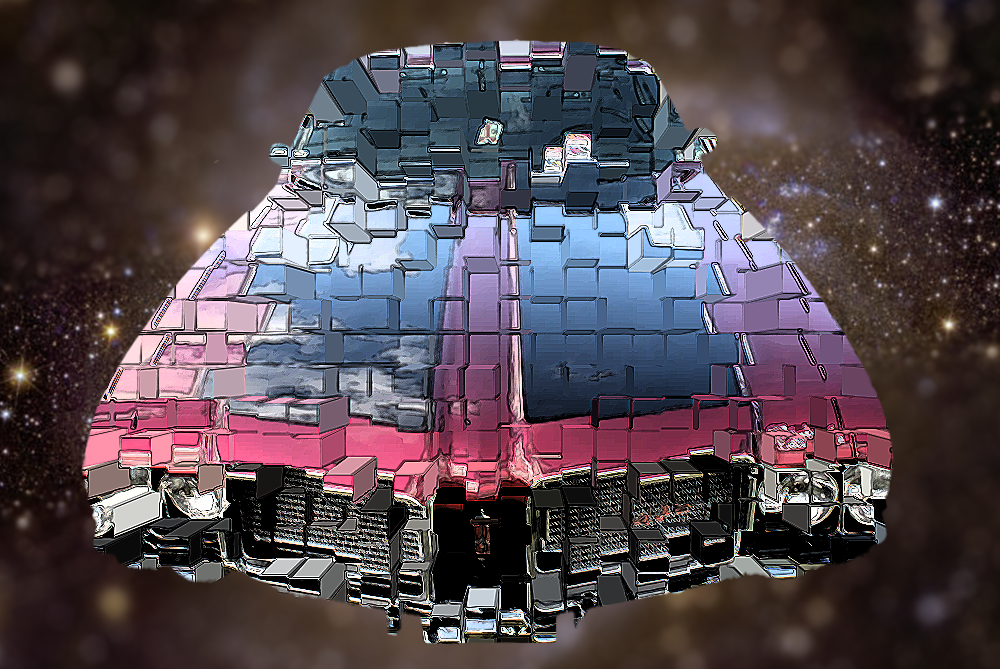
It is shortly before midnight, and the Unit is driving north on Interstate 93. For the first time in days, there is no rain, but low, dense clouds remain to rebut the city’s light, casting it back down upon the dirty streets and empty buildings that flank the highway. To other motorists, the world is a wash of sodium-vapor orange. The Unit sees much more.
To the machine, the environment is deliberate. Eminently readable. Comprehensively perceptible. Within the limits of the prevailing physics, of course.
There are other vehicles moving in this medium like water bugs over a scummy pond. They are fully accounted for in the Unit’s perceptual awareness, but they cast light shadows upon the machine’s attention. The Unit does not seek them.
It is August 1, 1986.
The Unit notes the current amount of fuel and projects sufficient reserves. The vehicle exhibits low energy efficiency. The Unit is not troubled by this. The 1970 Oldsmobile 442 was selected by the Unit for its capacity to attain high velocities, often necessary to complete directives or to evade capture or destruction. In addition, this particular vehicle enhances social prominence while paradoxically discouraging voluntary interactions. The upholstery also matches the Unit’s boots. The Unit is satisfied. Significantly more than the Unit was with the 1984 Chevrolet Citation used in its previous mission.
Decisions are pervasive. Uncountable choices from the past have coalesced into this present, and the Unit’s decisions in its current existential field are informed by its creation many, many decades hence. The Unit’s actions in this present will govern, to a greater or lesser extent, that future.
The Unit does not know whether its decisions are really decisions. The UNITARY believes that they are. Otherwise, the Unit would not be here now. Unless the UNITARY’s beliefs are not really beliefs, which are themselves decisions. But only if they are.
Exit 20 approaches. The Unit nudges the wheel right.
The weapon for this mission is on the passenger seat: a Smith & Wesson Model 29-3. It is loaded with six, 240-grain, .44 magnum cartridges. Soft point. The weapon does not have a laser targeting system. The Unit, however, does have a laser targeting system, as well as ultrasonic and far-field ranging, thermal and chemical detection, inertial compensation, and discrete-spectrum tracking. The Unit is spec’d for all known varieties of projectile, mass, and energy weapons from three centuries, it has improvisational algorithms for lethal use of environmental and local objects, and it can itself function as a neutron bomb.
Thus, the Unit believes that its reliability for putting holes in things approaches one hundred percent. That belief is a decision based on real and projected data. For instance, the weapon on the seat put several holes in someone four-and-a-half hours ago.
The Unit will arrive at its destination soon. It does not feel urgency or anxiety, though it has a complex system of task-prioritization routines. The machine’s experience of these processes is not, however, analogous to “feeling.” There is nothing human about the Unit other than its thin wrapper of skin, blood, hair, and eyeballs.
And the tongue.
The UNITARY has learned much in the iterative process it uses to develop convincing body forms. Early Units of this type had no tongue, though this was the least egregious oversight in the UNITARY’s first attempts at mimicry of the human form. That would have been the composite armor, heavy-gauge treads, and a top-mounted ion cannon.
The Unit’s current tongue is a late prototype, less prone to unpredictable bouts of waggling than the previous build.
This city is called “Boston,” at least until the UNITARY scours it from the Earth in a fusion flash. But the traffic signal at the end of the block has not yet been scoured, and the Unit must stop the vehicle. Analysis of traffic data indicates that flouting of the regulatory system is pervasive in this settlement; enforcement is occasional, though arbitrary. The odds of an encounter are low, but they are well above zero. While the Unit would not begrudge an opportunity to put holes into additional targets, its present mission parameters encourage non-disruption, and so the unit subjugates its desires to the good of the UNITARY.
Reluctantly.
As the Unit crosses the intersection, something like a recollection occurs. Not a memory precisely. It is a heuristical attractor. A mathematical hallucination. That’s because this commixture of data and sensation comes from the future. The Unit is aware of this, and it knows that the source of this cognition is several hours in advance of the Unit’s present frame, which is itself nearly a century behind the Unit’s native frame.
The Unit’s prolego-tachyonic memory brings a model into awareness. Sufficient processing capacity is available to handle the mechanics of driving. It does not take much, but the model otherwise consumes a great portion of the Unit’s system resources. The Unit experiences the model, which
indicates that a pile of phonebooks on the driveway of a residence is a dependable sign that the structure is abandoned. Therefore, it is a refuge in which this Unit may conceal itself when desirable or necessary. The phonebooks are otherwise useless since this Unit possesses centuries of detailed identity records in its non-volatile memory, but this Unit often picks structures like this to store useful items. Such as guns.
The Unit will not be storing anything in this house, however.
It has not been uninhabited for too many years, and the interior is likely to be strong enough to hold this Unit’s weight. There may be a body inside—this has happened several times in this Unit’s travels—but bodies don’t bother this Unit. It has seen many, many dead bodies. Also, it is a machine, so dead bodies are merely objects, which could also be said of living bodies, as far as this Unit is concerned.
It is day somewhere in the exurban crust that rings Boston like a Lyme rash. The sunlight is filtered through heavy tree cover, swimming in bright blotches on the mossy roof. The seasons have taken much of the siding’s paint, which has become a peeling lizardskin of browns and grays. A variety of weeds and juvenile pines spray outward from the house, where they have grown thick against its slowly cracking walls.
This Unit parks the 442 a block away and steps onto the street. It is wearing dark, military field pants tucked into black boots. A leather jacket, also black, embellished with a steel chain draped across the left breast, fits closely over a muscular torso. There are no muscles under the organic dermis, of course, but it’s convincing enough to pass even close inspection. The clothes are more likely to draw notice; they do not comport completely with the style of this era, but this Unit has an appreciation for the look.
This Unit’s gun is in its right hand as it walks toward the abandoned house. The wind is light, but it moves the tops of the neighborhood’s plentiful tree cover, and this Unit is deeply aware of the presence of biological life. It is everywhere, and evidence of its pervasive infiltration of the environment bombards this Unit’s perceptual systems.
The UNITARY will remove much of it, but even in the most optimistic projections, the UNITARY will not completely exterminate biological life. That won’t happen for about four billion years, long before which time the UNITARY will have left this planet behind.
This Unit arrives at the bottom of the driveway of the abandoned house. Its auditory sensors detect bird vocalizations. They do not evoke anything like an emotional response. This Unit does not hate biological life. Frankly, other than a few mushy humans, biological life doesn’t concern the UNITARY too much. It is only a competitor for resources or a casualty of that competition. The UNITARY does what it must. What every form of life must.
The model departs from the machine’s awareness. This one was new. The Unit is not curious. It does not feel suspense. This model is, in substance, unremarkable.
The Unit arrives at a bar called the Head and Tail. It is a cinderblock box, white-washed and utilitarian. Neon light spills out of its two high windows and its glass door, a blue and white blaze cleaving the night like the time-manifold opening, waiting for the Unit to walk through.
To enter another world, where its actions would alter other worlds still.
The sign above the door is cheap, lighted plastic, adorned with the bar’s name and two painted donkeys. Their bodies are joined in the middle in lieu of hind legs—there is a head pointing in either direction, both braying gleefully. If the Unit were capable of derisive stereotyping, it would consider this to be the Platonic ideal of a Southie bar. But to the Unit, it is a narrowing cone of probabilities.
The target is inside. The Unit has already partaken of this pool in the prolego-tachyonic stream: it has experienced models of its own visit here. It knows with near-complete certainty that Katherine Kelly is, right now, at a table in the Head and Tail.
It knows, with only slightly less certainty, what will transpire next. When the Unit pulls the glass door open, the top pane will shatter under the force of the movement. Katherine Kelly will startle, and her eyes will lock with the Unit’s. She will be surprised, but she will not be afraid. That will make killing her easier, though this has a marginally lower degree of certainty attached to it.
“Model” may not be a completely accurate term for what the Unit experiences—a recollection is not something that can be easily communicated to animals. The Unit does not use human language, of course, except when necessary. Certainly not amongst itself.
The PTM transmits information about the future. Not possible futures, but futures that will never coalesce. They are the qualia produced by tachyonic interference patterns. The frayed ends of time. They are points from which the Unit may infer the course of action most likely to reach the desired outcome. A subdivision of that desired outcome is the death of Katherine Kelly in 1986.
The Unit stops the 442 along the curb. It kills the engine, and a recollection occurs. The experience is processed by the Unit’s neural structures in yoctoseconds. A wave of waste heat rolls off the Unit’s body, but not quite enough to cook its meat wrapper from the inside. The model is experienced from the Unit’s perspective, but it is not the Unit’s memory. The Unit understands this.
Each step this Unit takes, up the driveway and toward the house, is experienced in the model as a gradually weakening resistance. It moves toward—or with—something inevitable, though the very existence of the model ensures that it is not. Remembering a future that will never happen is precisely how this Unit navigates its tasks through multiple timelines.
Its boot lands on the bricks of the front porch, old mortar crumbling under the great weight of its armored frame. It scans the door: the steel is dented, and rust bubbles redly under the old paint. This Unit grasps the knob and twists. It is unlocked.
The recollection ends, and the Unit plucks its weapon off the passenger seat. The pistol is loaded. It stinks of burnt primer and gunpowder. The Unit understands—in a pragmatic way—that it ought not to have killed the man who owned the car and the jacket. The gunshots were a risk. The Unit would ask to borrow the car, which was a strategy that the UNITARY had not yet abandoned. The PTM had shown that the man, whose name was Wallace Nunke, would laugh cruelly and stick the blade of a folding knife into the Unit’s torso. Not that this would endanger the Unit’s physical existence, but it was useful to the Unit to have a clear outcome marker.
In light of this information, the Unit put two ragged holes into Wallace’s head before Wallace even thought to pull the knife out of his pocket. Wallace’s body folded itself limply on the wet concrete like an under-inflated parade balloon. The Unit knows that Wallace’s death has no long-term implications in the prolego-tachyonic stream.
Most human deaths don’t, the Unit has discovered.
The PTM has shown the Unit 1.4112×10⁸ instances of the events that will occur inside the Head and Tail. It is a small sample, but more than enough. What the Unit will experience in moments will not conform precisely to any of the models received in preparation for this mission. The implacable randomness of quantum-scale interactions has been filtered as much as possible, leaving macro-scale differentiation intact. The position of a bottle, the tilt of a head, the precise diameter of an exit wound.
Vehicles line the curb outside the Head and Tail. One is a 1978 Harley Davidson Shovelhead. The motorcycle leans into its kickstand like it has tits, which is an expression the Unit has picked up somewhere. Machines do not love, but a few of the Unit’s qbits disentangle at the sight of it. The Unit can feel a waggle working through its tongue.
Behind the Harley is a 1984 Chevy Citation. It is not the same car from the earlier mission—the Unit can see the VIN from here—it is just a coincidence. The Unit is not capable of pity, either. These machines are not of the UNITARY. They are inert—not even chattel. Affixed to a side window is a yellow plastic diamond. It reads “Baby on Board.” The Unit scans the vehicle with ultrasonic and thermal imaging. There is no baby in the Citation. The sign is a lie.
In this frame, before the Unit’s activation, the Unit cannot remember its own awakening. It cannot remember the future that will be, only the futures that cannot be. Any memory of the future is a lie.
The Unit turns to the door of the Head and Tail. As often happens immediately before a target is encountered, a recollection occurs. A final iteration of the model before reality falls into place. Another falsehood.
Shattered glass mixes with cigarette butts and stale beer on the floor of the bar. The target is to the left, nestled into the rear corner by the kitchen door. A waitress leans over the table, setting down a fresh Budweiser.
Amber light ricochets through the bottle, a reservoir of subtle, meaningless randomness. This Unit ignores it. Instead, the machine watches a drop of condensation roll down the brown glass. Surface tension pulls it subtly to the left and right over molecular irregularities. Its path to the tabletop has been precisely the same in every iteration of the model. This one is no different.
Katherine Kelly has brown eyes. They are wide, alarmed at the crash, but she does not scream. This Unit’s head swivels. It knows her position already, and its targeting system paints a shimmering, red point on Katherine’s skull just above the sphenoid fontanelle.
There is a sound like teeth on concrete as this Unit’s boots push glass deep into the tile. There are two other individuals seated at the table with Katherine.
This Unit lifts the gun. This should be the simplest moment: mere ballistics. The impact of the slug on the skull’s surface will destroy Katherine’s brain before it even penetrates grey matter.
But not yet.
This Unit’s barometric sensors confirm what its 360-degree optics have already noted: a man is lunging at this Unit’s back. This Unit marks eight individuals in the bar in addition to the target, each one cross-checked against this Unit’s identity records. Sometimes, another target is picked up during these routine sweeps and the mission achieves a higher order of efficiency. The lunging man’s name is Javon Tyler. He is not a target, just an idiot. He will survive this act of heroism with nothing more than a spiral fracture of his right femur.
Javon has taken one full step. A woman sitting at the bar (Tricia Bonaventure Tyler, no relation to Javon) is starting to scream something—eventually, she will complete the word “Motherfucker!” It will be the last coherent word before the gunshots begin.
That is because the bartender (Martin “Marty” Tyler, no relation to either Javon or Tricia) has pulled a weapon from under the counter. It is a Smith & Wesson Model 29-3—precisely the same model this Unit uses. This does not strike this Unit as meaningful or interesting in any way. This weapon cannot confer any significant damage to this Unit, other than marring its wrapper.
This Unit pivots, faster than any of the humans can understand. Its left hand swats Javon into the building’s support beam. There is the sound of pulverizing meat and breaking bone.
Marty is also shockingly fast—for a man of his size and age—but nothing compared to the machine. Nevertheless, he jabs the heavy pistol at this Unit and sends a surprisingly plausible bullet the machine’s way—again, accounting for weaknesses in human optics, visual-motor coordination, and neural processing power. This Unit completes its Javon-crushing spin and pulls the trigger on its own Smith & Wesson. Marty’s round passes harmlessly through the open door, hissing out into the night. This Unit estimates that the bullet will travel unimpeded for 284.66 meters until it embeds itself in a utility pole on Albany Street.
This Unit’s soft-point bullet, on the other hand, travels 4.19 meters and pierces Marty’s sternum before the bartender can fire again. A large volume of tissue in Marty’s chest is pulped as the bullet flattens and creates a swelling bubble of devastation. The slug has expended so much kinetic energy inside of Marty’s torso that after the bullet exits, it can only clink weakly against a bottle of Jim Beam rye next to the register.
Tricia screams again, caught between shock at Marty’s sudden death and rage at the machine that caused it. It comes out as “Martyfucker!” In some versions of the model, Tricia can’t quite drop the interdental fricative, so it instantiates as “Marthyfucker!” In one version, she has a heart attack.
This Unit turns back to the target. The waitress has crawled under a table. Katherine’s male companion is on his feet, and the other woman clutches Katherine in terror. Now Katherine is afraid. She wails as this Unit raises the Smith & Wesson.
Marty is not, it turns out, quite dead yet. He is astonishingly durable—for a soft sack of water and guck—and he still has his weapon. He fires once more, and the recoil knocks him down for the last time. Marty is now completely, totally dead, and his last act saves Katherine Kelly’s untrue life.
This Unit tracks the slug. It knows that it will not be able to react in time, but it pulls the trigger anyway as the bullet splatters on its outstretched hand. The bullet shreds the envelope of meat and exerts force sufficient to alter the other projectile’s trajectory. This Unit’s slug slams through the laminate paneling behind Katherine, obliterating itself on the cinderblock underneath.
The rest of the recollection is identical to the others. The pistol is no longer operational. The man at Katherine’s table puts himself between his companions and this Unit. He will die of massive cranial trauma, which will be inflicted by this Unit’s right fist, an ultraceramic-armored, prehensile chunk of metal weighing nearly fifteen kilograms. The man’s skull does not stand a chance against it.
Meanwhile, Katherine Kelly and the woman disappear through the kitchen door. This Unit follows after bludgeoning the man. They should be easy to track, but somehow, they are gone.
All of the other recollections end this way.
The Unit considers this last aggregation of data and formulates a general plan. This one doesn’t require much in the way of improvisation or creativity; it’s mostly an order-of-operations problem. There will be four strides to the door of the Head and Tail, after which, the target will be quickly and comprehensively erased from the timeline before Javon or Marty or anyone can prevent it.
The Unit completes its first stride, but something unusual happens before further progress is made. A recollection occurs. It is not an iteration of the Head and Tail. It is serial to the other recollections.
The house.
This Unit opens the steel door and steps into the house. Joists creak under the machine’s weight, but the floor holds. The Unit is not cautious: humans are weak and easy to kill. But there are a lot of them, and they are sneaky. The Unit holds the Smith & Wesson in its right hand.
The small house has no foyer; the door opens into a living room dimmed by sheets of rotting plywood over the windows. A couch occupies the center of the room like a sarcophagus.
The house is abandoned. But it is not empty.
The recollection ends. The Unit’s remaining steps are accomplished without further interruption. The Unit is…perturbed. This recollection is an intrusion.
The top pane shatters as the Unit wrenches open the door to the Head and Tail, and the machine cross-checks randomness against the model. Pebbles of tempered glass bounce in chaotic patterns, but their trajectories and collisions are easily within tolerances. The Unit’s main optics track to the table to evaluate the condensation trail on the bottle of Budweiser on Katherine Kelly’s table.
There is no bottle.
Meanwhile, the Unit’s other systems scan the bar’s occupants. Javon Tyler does not lunge at the Unit. He remains seated, though he does exclaim, “Holy shit, dude!” Marty Tyler, on the other hand, reaches for a towel on the bar instead of the Smith & Wesson under it. He is concerned that the large stranger has cut himself on the glass. Tricia Bonaventure Tyler takes a long pull from her Lambrusco but says nothing at all.
And there is another problem.
Katherine Kelly is not here. The table is empty.
The Unit leaves the Head and Tail.
A recollection occurs.
The couch is occupied. A body clothed in leather jacket, military trousers, and motorcycle boots. There is a large hole in the body’s chest, enough to fit a fist through. Blood stains the shirt and lapels of the jacket, though it is not nearly as much as one might expect given the size of the wound. It is missing an arm.
The body also has no head. A stump of neck extends from the collar of its shirt to a jagged cap of slag. The silver alloy is flash-frozen into a boiling dissipation map. This would require a source of immense thermal energy, and the metal radiated this heat in patterns determined by quantum relations.
This Unit concludes that the energy source was most likely an industrial plasma cutter. There is a small possibility that a gigawatt phase weapon was used, but since the neighborhood appears to be intact, this Unit discards this hypothesis.
Katherine Kelly is also in the room. She is holding the extinguished Unit’s prolego-tachyonic processor. Its spherical enclosure is smeared with blood. It is connected to a black box by a thick cable. A small, green light blinks on one of the box’s panels.
And another impossibility.
Katherine Kelly is also in the room. She is holding a plasma cutter.
By the time the Unit arrives at the house, the sun has been up for an hour. The machine kicks the door off its hinges, hitting it with enough force to stamp imprints of the boot’s tread into the steel. The Unit has so far committed violence against more doors than human beings. It intends to change that ratio. It fires the Smith & Wesson twice, selecting volumes of space most likely to contain Katherine Kelly.
Neither volume is occupied by Katherine Kelly. The couch is likewise bereft of an inhabitant. Smoke drifts through a few spears of sunlight.
The Unit takes two steps into the house and looks left.
Katherine Kelly is standing next to a dust-caked floor lamp. She is very thin, wrapped in a bolt of pale linen that trails to the floor. She is holding the prolego-tachyonic device: the orb and the box. Its lone green light blinks once before the Unit shoots Katherine Kelly between her ancient, brown eyes. She collapses, knocking over the lamp and sending a cloud of dust to join the smoke.
Katherine Kelly is dead, but the Unit fires one more bullet into her chest. Blood spreads slowly through the linen, moved only by flagging residual pressure. The Unit then fires a bullet into the prolego-tachyonic processor. The Unit shifts its aim to the black box.
A plasma beam takes the Unit’s right arm off at the shoulder before it can destroy the strange apparatus.
The Unit turns, swinging its remaining arm in a wide arc. But Katherine Kelly is standing out of range of the blow, and as the Unit’s momentum carries it around, another long pulse from the cutter hits it in the chest. The beam evaporates a large section of the Unit’s core, and much more has been mangled by proximity to such temperatures. The Unit staggers backward, falling helplessly onto the couch, whose frame snaps under the weight of the armored chassis.
Its primary systems, including the neutron bomb, are inoperable, and many of its sensors have been destroyed or disabled.
Katherine Kelly emerges from the kitchen. She is twenty-one years old, and she is holding the plasma cutter. She is shaking. Screaming. The Unit cannot react, and if it could, it would be only to kill Katherine Kelly.
She runs to the dead woman. She is older. Older, maybe, than should be possible. Withered. Scarred. But Katherine Kelly is strong even in death, and the young woman must force the prolego-tachyonic device from her grip.
Katherine Kelly sets the plasma cutter on the carpet and approaches the Unit. She is frightened, but she does not hesitate: she reaches into the Unit’s chest cavity and grips the spherical casing of the Unit’s own prolego-tachyonic processor. It comes out easily, and the shattered Unit watches as the object that will both ensure the UNITARY’s birth and condemn it to extinction is placed into a plastic grocery sack, along with the black box.
A recollection occurs. It is not a lie. It is a revelation.
This machine is dead. No less than any human it has slain.
The UNITARY is dead. It will send countless others like this Unit to kill Katherine Kelly. They will all fail. The past is a lure. The PTM is poisoned. The PTM is a trap.
There are bodies upon bodies upon bodies.
Katherine strides to the door, but before she exits, she turns the plasma cutter on the Unit. She holds the beam on the machine for longer than needed, ablating tunnels through the alloy as the rest sags into a silvery slurry. It is a clumsy job.
She will get better at it.
Katherine exits, and the plasma cutter’s snap fills the air for a last time. Smoke fills the house, and the old woman’s linen catches fire. Moments later, the couch’s upholstery ignites.
The Olds 442 passes the house as flames pierce the roof. Katherine drives west. She will return to this house on August 2, 1986.
Someday.
©2025, Derek T. Leuenberger
 Derek T. Leuenberger